How To Write SEO Blog Posts That Rank In 2026 (Complete Beginner Guide)part-2
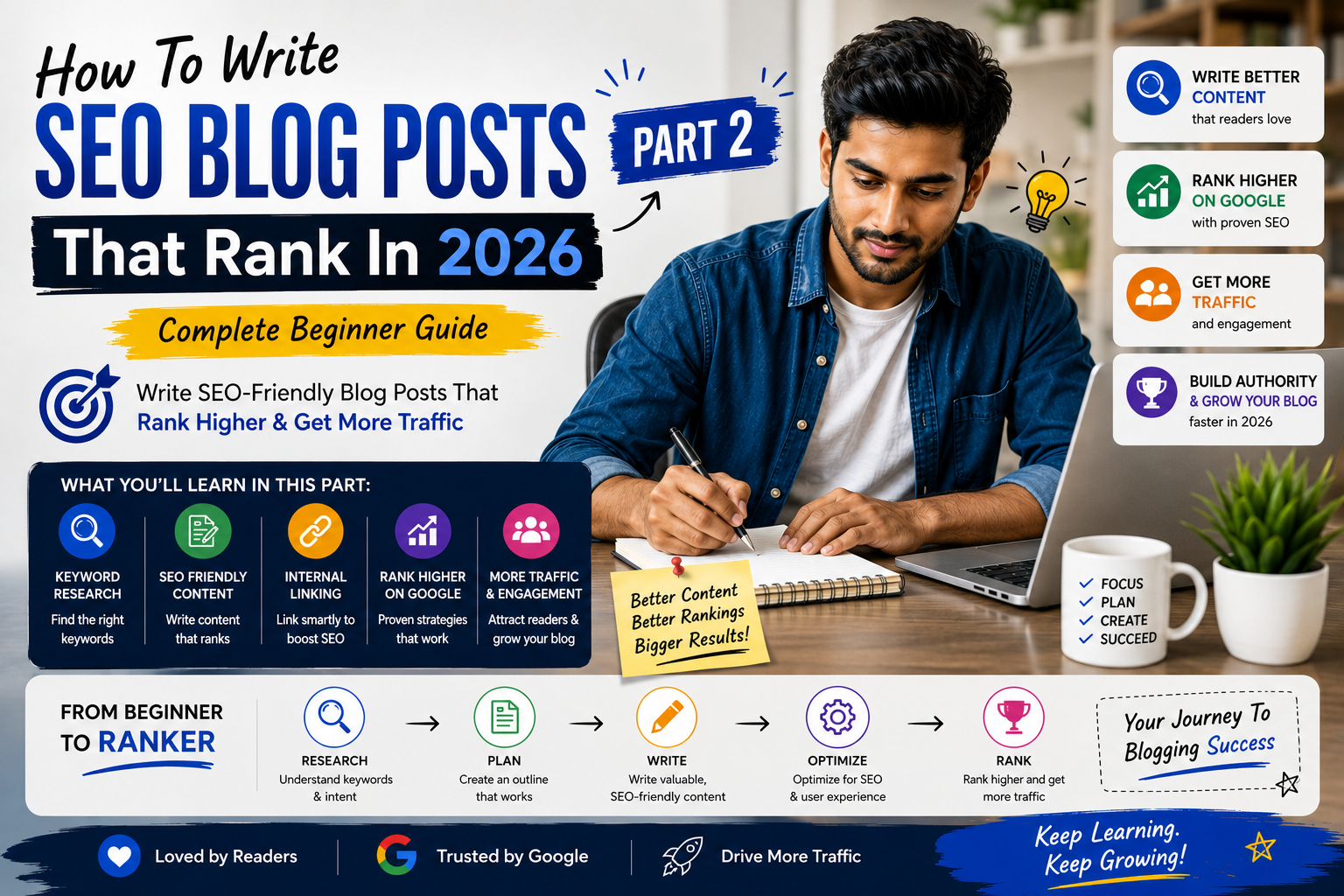
Welcome to Part 2 of this beginner's guide to SEO blog writing!
Part 1 (SEO Basics)
In Part 1, you learned the fundamentals of SEO blog writing, including what SEO blog writing is, why high-quality content matters, how Google discovers and ranks web pages, and why creating helpful, people-first content is essential for long-term SEO success.
Before You Start Writing
Before you start writing your blog post, there's some important preparation to do. Many beginner bloggers jump straight into writing without a plan. They choose a topic, open a blank page, and start typing. While this might seem like the fastest approach, it often leads to unfocused content that struggles to rank on Google.
Successful bloggers know that great content starts long before the first paragraph is written. They spend time researching the right keyword, understanding what their audience is searching for, and analyzing the top-ranking pages. This preparation helps them create content that answers real questions, provides genuine value, and has a much better chance of appearing in search results.
Think of it like planning a road trip. Before you begin driving, you decide where you're going, choose the best route, and check the map. Writing an SEO blog post works the same way. A clear plan helps you stay on track and reach your destination faster.In this part of the guide, you'll learn how to choose the right keyword for your topic, understand the search intent behind that keyword, and analyze the top Google results to discover what readers expect. These three steps will give you a strong foundation before you start writing and make the entire writing process easier and more effective.
Let's begin by learning how to choose the right keyword for your blog post.
4. Choose the Right Keyword
Every successful SEO blog post starts with one important decision—choosing the right keyword.
A keyword is the word or phrase that people type into Google when they are looking for information, answers, products, or services. It tells search engines what users want to find and helps Google match the most relevant content to their search.
For example, if someone wants to learn how to start a blog, they might search for:
Each of these search phrases is a keyword.
As a blogger, your goal is to choose a keyword that matches your topic, helps your target audience, and gives your content a realistic chance of ranking on Google.
If you're new to keyword research, don't worry. You don't need expensive SEO tools to find great keyword ideas. We have already covered the complete process in our guide, Keyword Research For Bloggers Using AI In 2026, where you'll learn how to discover profitable keywords, use AI tools effectively, understand keyword difficulty, and find topics that have the potential to rank on Google. If you haven't read it yet, we recommend checking it out before continuing with this guide.
5. Understand Search Intent
Choosing the right keyword is only the first step in SEO. To create content that ranks well, you also need to understand search intent. Search intent, also called user intent, is the reason behind every search query. It explains what a person is trying to find when they type something into Google.
For example, if someone searches for "How to Write SEO Blog Posts," they are most likely looking for a complete step-by-step guide that teaches them the entire writing process. They expect practical advice, examples, and actionable tips. If your article only gives a brief definition of SEO blog writing without explaining the steps, readers won't find what they were looking for. As a result, they may leave your page and continue searching for another result.
Google pays close attention to user behavior. When visitors quickly leave a page because it doesn't answer their question, it sends a signal that the content may not be satisfying their needs. Although many factors influence rankings, creating content that matches search intent helps improve user satisfaction and increases your chances of performing well in search results.
Instead of asking yourself, "What do I want to write about?" ask a more important question: "What does my audience want to learn?" When your content answers that question better than competing articles, you're much more likely to earn your readers' trust and improve your visibility on Google.
Why Search Intent Matters
Imagine two bloggers targeting the same keyword. The first blogger publishes a detailed guide with clear explanations, practical examples, helpful screenshots, and answers to common questions. The second blogger writes a short article with very little useful information. Most readers will naturally find the first article more valuable because it completely solves their problem instead of leaving them with more questions.
Google's goal is to recommend content that gives users the best possible answer. That's why articles that match search intent often perform better in search rankings. When your content satisfies readers, they spend more time on your website, explore additional pages, and are more likely to return in the future. Matching search intent also helps reduce bounce rates, build trust with your audience, and improve your overall SEO performance.
The Four Types of Search Intent
Most searches on Google fall into one of four main categories. Understanding these categories helps you create the right type of content for each keyword.
The first type is Informational Intent. In this case, users simply want to learn something. They may search for topics like "What is SEO?", "How to start a blog," "Blogging tips for beginners," or "How Google ranks websites." These searches are best answered with educational, easy-to-understand articles that explain concepts clearly and provide useful examples.
The second type is Navigational Intent. Here, users already know where they want to go and use Google as a shortcut. Searches such as "Gmail Login," "YouTube Studio," or "WordPress Dashboard" are examples of navigational intent. Since users are trying to reach a specific website or page, blog posts usually aren't the best content format for these searches.
The third type is Commercial Investigation. At this stage, users are researching different options before making a decision. They might search for "Best AI SEO tools," "Best blogging platform," "Grammarly vs Pro Writing Aid," or "Hostinger vs Bluehost." They want detailed comparisons, honest reviews, pricing information, pros and cons, and recommendations to help them choose the best option.
The final type is Transactional Intent. These users are ready to take action, whether that's making a purchase, signing up for a service, or booking something online. Searches like "Buy web hosting," "Purchase an SEO course," "Premium WordPress themes," or "SEO writing services" usually lead to product pages, pricing pages, or service pages instead of informational blog posts.
How to Identify Search Intent
One of the easiest ways to understand search intent is to search your target keyword on Google and carefully study the first page of results. Google has already analyzed what users expect, so the top-ranking pages provide valuable clues about the type of content you should create.
Pay attention to the format of the results. Are most pages beginner guides, detailed tutorials, product reviews, comparison articles, videos, or online stores? If nearly every top-ranking result is a comprehensive guide, publishing a short 500-word article is unlikely to compete successfully. Instead, create a detailed article that answers every important question readers might have.
Match Your Content to User Expectations
Once you've identified the search intent, shape your content to meet those expectations. If people are looking for a beginner's guide, explain every step in simple language and avoid unnecessary technical terms. If users want a comparison, include features, pricing, advantages, disadvantages, and your recommendations. If they're searching for a tutorial, provide clear step-by-step instructions with screenshots or real examples whenever possible.
Always focus on the reader's goal rather than simply adding keywords throughout your article. The more accurately your content matches what people expect to find, the longer they'll stay on your page and the more likely they are to trust your advice.
Search Intent and SEO Work Together
Keywords and search intent serve different but equally important purposes in SEO. Your keyword tells Google what your content is about, while search intent helps Google determine whether your article actually answers the user's question. Both elements are essential for creating content that performs well.
Even a perfectly optimized article with excellent keyword placement can struggle to rank if it doesn't satisfy the reader's intent. That's why modern SEO is no longer just about inserting keywords into a page. Instead, it's about creating helpful, people-first content that genuinely solves problems and provides value.
Common Search Intent Mistakes
Many beginner bloggers make the mistake of creating content that doesn't match what users are searching for. Some write about topics that are only loosely related to their target keyword, while others ignore the common questions readers want answered. Another common mistake is publishing promotional content when users are looking for educational information, or writing very short articles for subjects that require detailed explanations.
Before you publish any blog post, ask yourself one simple question: "If I searched this keyword, would this article completely answer my question?" If your answer is yes, you're creating content that is much more likely to satisfy both readers and search engines.
Pro Tip
Whenever you're unsure about search intent, let Google guide you. Search your target keyword, study the highest-ranking pages, and look for patterns in the type, structure, and depth of content Google is already rewarding. This simple habit helps you understand what readers expect and allows you to create content that offers even greater value than the existing results.
Key Takeaway
Choosing the right keyword tells you what to write about, while understanding search intent tells you how to write it. When you combine both, you create content that meets your audience's expectations, provides genuine value, and has a much better chance of ranking on Google.
In the next section, you'll learn how to analyze the top Google results, identify content gaps, and create an article that delivers even more value than the current competition.
6. Analyze the Top Google Results
After you've chosen the right keyword and understood the search intent, there's one more step you should complete before you start writing your blog post—analyzing the top Google results.
Many beginner bloggers skip this step because they think it's only for SEO experts. In reality, it's one of the easiest ways to improve your content and increase your chances of ranking.
When you search your target keyword on Google, the first page is filled with articles that Google already considers helpful and relevant. These pages have earned their positions because they answer users' questions effectively.
Your goal is not to copy these articles. Instead, study them to understand what works, identify what's missing, and create something even more useful for your readers.
Why Analyze the Top Google Results?
Think of Google's first page as a source of valuable information.
The top-ranking articles can show you:
Instead of guessing what to include in your article, you can learn from pages that are already performing well.
This saves time and helps you create content that better matches both user expectations and Google's ranking signals.
Search Your Target Keyword
The first step is to search your primary keyword on Google. Use an incognito or private browsing window so your previous search history doesn't influence the results. Instead of focusing on just the first result, review at least the top five to ten pages. This gives you a broader understanding of how different websites approach the topic and what type of content consistently performs well.
Instead of guessing what to include in your article, you can learn from pages that are already performing well.
This saves time and helps you create content that better matches both user expectations and Google's ranking signals.
How to Write SEO Blog Posts
Open the articles and study how they are written.
Ask yourself:
Take notes as you go.
You'll quickly notice patterns that can help you plan your own article.
Study the Article Structure
One of the first things to look at is the structure of each article.
Notice how the content is organized.
For example:
A clear structure makes an article easier to read and helps readers find the information they need quickly.
If several top-ranking pages cover similar sections, it's usually a sign that those topics are important.
You don't need to copy their structure exactly, but it can help you build a logical outline for your own article.
Check the Quality of Their Content
While reading the top-ranking pages, ask yourself:
If you can explain the same topic in a simpler way or provide more useful examples, your article immediately becomes more helpful.
Remember, readers appreciate clear explanations more than complicated language.
Pay Attention to Images and Visuals
Many successful articles include visual elements that make the content easier to understand.
Visuals help readers learn faster and keep them engaged.
if a topic is difficult to explain with text alone, consider adding an image or diagram.
Look at the Frequently Asked Questions
Many top-ranking articles include an FAQ section near the end.
These questions often come directly from Google's "People Also Ask" feature or from real user searches.
Adding an FAQ section helps answer additional questions readers may have and can improve your chances of appearing in Google's search features.
Don't Copy Your Competitors
One of the biggest mistakes beginners make is copying articles that already rank well.
Google values original, helpful content. if your article is simply a rewritten version of someone else's work, it offers very little value.
The goal is to create the best resource, not a duplicate.
Build Better Content
Your goal should always be to publish something more helpful than what's already available.
You don't have to write the longest article.
You need to write the most useful one.
You can improve your content by:
Small improvements across your article can make a big difference.
A Simple Competitor Research Checklist
Before you start writing,
ask yourself these questions:
✔ Have I read the top-ranking articles?
✔ Do I understand what readers expect?
✔ Did I identify any missing information?
✔ Can I explain the topic more clearly?
✔ Am I adding original value instead of copying?
✔ Will my article genuinely help beginners?
If you can answer "Yes" to these questions, you're ready to start writing.
Small improvements across your article can make a big difference.
✅ What You Learned in Part 2
In this part, you learned how to prepare for writing an SEO-friendly blog post. You now understand how to choose the right keyword, identify search intent, analyze the top Google results, and find opportunities to create content that offers more value than existing pages.
Key Takeaway
✅ How to choose the right primary keyword
✅ The difference between primary, secondary, and long-tail keywords
✅ Why search intent matters for SEO
✅ The four main types of search intent
✅ How to analyze Google's top-ranking pages
✅ How to identify content gaps
✅ Why adding unique value improves your chances of ranking
Analyzing the top Google results is one of the smartest things you can do before writing a blog post.
It helps you understand what already works, discover what readers expect, and identify opportunities to create something even better.
Don't think of competing articles as obstacles. Think of them as research. Learn from their strengths, improve on their weaknesses, and focus on creating the most helpful content possible.
By combining the right keyword, search intent, and competitor research, you'll have a strong foundation for writing SEO-friendly blog posts that provide real value and have a better chance of ranking on Google.
In the next part of this guide, you'll learn how to turn your research into a well-organized article by creating an SEO-friendly outline, writing an attention-grabbing title, and crafting an introduction that encourages readers to keep reading.