
How To Write SEO Blog Posts That Rank In 2026 (Complete Beginner Guide)

Write SEO Blog
Have you ever spent hours writing a blog post, only to receive little or no traffic from Google? You're not alone. Many beginner bloggers create content regularly but struggle to rank because they don't understand how SEO blog writing works.

The good news is that writing blog posts that rank on Google isn't about using complicated tricks or stuffing keywords everywhere. In 2026, successful SEO is all about creating helpful, well-structured content that answers readers' questions better than anyone else.

Whether you're starting a new blog, growing an existing website, or using AI tools to create content, learning how to write SEO-friendly blog posts is one of the most valuable skills you can develop. A single well-optimized article can bring visitors to your website for months or even years.

In this complete beginner's guide, you'll learn the entire SEO writing process—from choosing the right keyword and understanding search intent to creating engaging content, optimizing your headings, adding internal links, and publishing articles that have a better chance of ranking on Google.

By the end of this guide, you'll have a simple step-by-step system that you can use every time you write a new blog post.

What You'll Learn

In this guide, you'll discover:

  • What SEO blog writing is and why it matters
  • How search engines understand your content
  • How to choose the right keywords
  • Why search intent is more important than keyword density
  • How to create a perfect blog outline
  • How to write engaging introductions and headings
  • Best practices for on-page SEO
  • How to optimize images and internal links
  • Common SEO writing mistakes to avoid
  • A complete SEO blog writing checklist before publishing

Who Is This Guide For?

This guide is perfect for:

  • Beginner bloggers
  • Content creators
  • Affiliate marketers
  • Small business owners
  • Freelancers
  • Digital marketers
  • Anyone who wants more free traffic from Google


No previous SEO experience is required. Everything is explained in simple English with practical examples.

Why You Should Learn SEO Blog Writing in 2026

The internet is more competitive than ever, with millions of blog posts published every day. Simply writing good content is no longer enough. To stand out, your content needs to be helpful, well-organized, and easy for both readers and search engines to understand.

SEO blog writing helps you:

  • Attract more organic traffic without paying for ads
  • Build trust and authority in your niche
  • Increase email subscribers and loyal readers
  • Generate more affiliate commissions and sales
  • Create content that continues bringing visitors for years


The best part is that SEO is a long-term investment. A well-written article can keep attracting visitors long after you've published it.

Remember This

Writing SEO-friendly blog posts isn't about tricking Google—it's about creating valuable content that satisfies your readers while making it easy for search engines to understand and recommend your pages.

Part 1: Build a Strong SEO Foundation

1.What Is SEO Blog Writing?

SEO blog writing is the process of creating blog posts that are easy for both people and search engines like Google to understand. The goal is to write helpful, valuable content that answers readers' questions while following SEO (Search Engine Optimization) best practices.

Unlike regular writing, SEO blog writing is planned around what people are searching for online. It includes using relevant keywords naturally, organizing content with clear headings, answering search intent, and making the article easy to read. These small improvements help search engines understand your content and increase its chances of appearing in search results.


Think of SEO blog writing as writing for two audiences:

  • Your readers, who want useful, accurate, and easy-to-understand information.
  • Search engines, which need clear signals to understand what your page is about.


The best SEO blog posts satisfy both audiences. They provide real value to readers while making it simple for search engines to crawl, index, and rank the content.

A Simple Example


Imagine someone searches on Google: 


If your article clearly explains the complete process, uses the right headings, includes helpful examples, and answers the reader's questions, Google is more likely to consider it a valuable result.

On the other hand, if your article is poorly organized, difficult to read, or doesn't fully answer the searcher's question, it is less likely to rank well—even if it contains the same keyword.

SEO Blog Writing vs. Regular Blog Writing

Understand the key differences and why SEO blog writing helps your content rank higher on Google.

🚀 SEO Blog Writing
🔍

Keyword Research

Every article is planned around keywords people actually search for.

🎯

Matches Search Intent

Answers exactly what users are looking for on Google.

📑

Proper Heading Structure

Uses H1, H2, and H3 headings for better readability and SEO.

Optimized for Google & Readers

Easy for both search engines and humans to understand.

🔗

Internal & External Links

Builds authority and improves user navigation.

🏆

Higher Google Ranking

Greater chance of getting consistent organic traffic.

✍️ Regular Blog Writing

No Keyword Planning

Content is written without researching search demand.

💭

Personal Ideas Only

May not answer what users are searching for.

📄

Weak Structure

Headings may be missing or used inconsistently.

👤

Reader-Focused Only

Often ignores search engine optimization.

🚫

Few or No Links

Misses opportunities to improve SEO and navigation.

📉

Lower Organic Traffic

Less likely to appear on the first page of Google.

The Four Key Elements of SEO Blog Writing

Writing an SEO-friendly blog post is more than just adding keywords. To rank well on Google and provide value to readers, every successful blog post should include these four essential elements.

📝 1. Helpful Content

The foundation of every great blog post is high-quality content. Focus on creating original, informative, and practical content that solves a real problem or answers a question your audience is searching for. When readers find your content useful, they are more likely to stay longer, share it, and return for more.

🔍 2. Smart Keyword Usage

Keywords help search engines understand what your article is about. Research your primary keyword and related terms, then use them naturally throughout your title, headings, introduction, body, and conclusion. Avoid keyword stuffing, as it can hurt both readability and SEO performance.

📑 3. Clear Structure

Well-organized content is easier for both readers and search engines to understand. Use descriptive H2 and H3 headings, write short paragraphs, include bullet points, numbered lists, tables where appropriate, and relevant images to improve readability.

⚡ 4. Great User Experience

A positive user experience plays a major role in SEO. Make sure your blog is easy to read on desktop and mobile devices, loads quickly, uses clear fonts and spacing, and has a clean, distraction-free layout.

💡 Quick Tip

The best SEO blog posts combine valuable content, natural keyword optimization, a clear structure, and an excellent user experience. When these four elements work together, your content has a much better chance of ranking higher in search results and attracting consistent organic traffic.

Why SEO Blog Writing Matters

Every day, millions of blog posts compete for attention on Google. Without SEO, even excellent content can remain invisible because search engines may not fully understand or recommend it.

SEO blog writing helps you:

  • Reach people actively searching for your topic.
  • Increase organic traffic without paying for ads.
  • Build trust and authority in your niche.
  • Improve user experience and engagement.
  • Generate more leads, subscribers, and income over time.


Instead of chasing quick results, SEO blog writing focuses on creating content that continues attracting visitors for months or even years after it's published.

Remember This

SEO blog writing is not about writing for search engines alone. It's about creating helpful, well-structured, and reader-focused content that search engines can easily understand and recommend. When you combine valuable information with smart SEO practices, your blog has a much better chance of ranking higher and attracting consistent organic traffic.

2.Why High-Quality Content Matters More Than Ever

In the early days of SEO, many websites ranked simply by repeating keywords multiple times or publishing large amounts of content. Those strategies no longer work. In 2026, search engines are much better at understanding whether a piece of content is genuinely helpful or created only to rank.

Today, Google rewards content that provides real value to readers. If your article answers questions clearly, solves problems, and offers useful information, it has a much better chance of earning higher rankings and long-term traffic.

Simply put, quality beats quantity.

Whether you publish one excellent article each week or one every month, a well-researched, reader-focused blog post is usually more valuable than publishing several low-quality articles.

What Is High-Quality Content?

High-quality content is content that helps readers achieve a specific goal. It is accurate, easy to understand, well-organized, and provides information that readers can trust.

A high-quality blog post should:

  • Answer the reader’s main question completely.
  • Be written in simple, easy-to-read language.
  • Provide accurate and up-to-date information.
  • Include practical examples and actionable tips.
  • Be free from grammar and spelling mistakes.
  • Offer original insights instead of copying other websites.
  • Keep readers engaged from beginning to end.


When your content genuinely helps people, readers are more likely to stay longer, share your article, and return to your website for more information.

Why Google Prefers Helpful Content

Google's main goal is to provide users with the best possible answer to every search query. If someone searches for:

🔍 "How to write SEO blog posts"

Google wants to show articles that explain the process clearly, answer common questions, and help readers take action—not articles filled with unnecessary keywords or copied information.

How Google Evaluates Content Quality

✅ Does the content answer the searcher's question?
✅ Is the information trustworthy and accurate?
✅ Is the article well-structured and easy to read?
✅ Does it provide original value?
✅ Will readers find it useful?
💡 Key Takeaway

The better your content satisfies these expectations, the stronger your chances of ranking well on Google.

Quality vs. Quantity

Many beginners think publishing more articles automatically leads to better rankings. In reality, one comprehensive, well-written guide can outperform dozens of short, low-quality posts.

Example Comparison

❌ Website A

  • Publishes 30 short articles every month.
  • Articles are only 400–600 words.
  • Little research.
  • Repeats the same information.
  • Poor formatting.

✅ Website B

  • Publishes 4 detailed guides every month.
  • Each guide is 3,500–4,500 words.
  • Well researched.
  • Includes examples, images, FAQs, and checklists.
  • Fully optimized for readers and SEO.

🏆 Which Website Will Rank Better?

For most topics, Website B has a much better chance of building trust, earning backlinks, and attracting consistent organic traffic because it delivers greater value to readers.

Write for People First, Search Engines Second

One of the biggest SEO mistakes beginners make is focusing only on keywords. While keywords are important, they should never come at the expense of creating valuable and easy-to-read content.

Instead, put your readers first. Think about what they want to learn, the problems they need to solve, and how you can provide the best possible answer. When your content genuinely helps people, search engines are much more likely to reward it.

Ask Yourself Before You Publish

  • 💡 What problem is my reader trying to solve?
  • ❓ What questions might they have?
  • 📖 What examples would make this easier to understand?
  • 🎯 What action should they take after reading?

When your article answers these questions naturally, SEO becomes much easier. Instead of writing for algorithms, you're creating content that builds trust, keeps readers engaged, and encourages them to return for more.

💡 Remember This Rule
"Write for people first. Optimize for search engines second."

This simple approach creates content that both readers and search engines appreciate, giving your blog a better chance of earning higher rankings and long-term organic traffic.

The Role of AI in Creating High-Quality Content

AI has become a powerful writing assistant for bloggers, marketers, and content creators. It can save time, improve productivity, and help you organize your ideas. However, AI should support your writing process—not replace your knowledge, creativity, or experience.

Think of AI as your assistant. It can help you create better content faster, but the final article should always be reviewed and improved by a human before publishing.

🤖 How AI Can Help You

  • 💡 Generate fresh content ideas.
  • 📝 Create detailed article outlines.
  • ✍️ Improve grammar and sentence clarity.
  • 🔄 Rewrite paragraphs for better readability.
  • 📑 Suggest engaging headings and subheadings.
  • ❓ Brainstorm useful FAQs for your readers.

👤 What You Should Always Do

  • ✔️ Verify facts, statistics, and sources.
  • ✔️ Add personal insights, examples, and real experiences.
  • ✔️ Remove repetitive or robotic sentences.
  • ✔️ Make sure the content reflects your unique voice and style.
💡 Best Practice

The highest-quality content is created by combining the speed and efficiency of AI with human creativity, expertise, and critical thinking. AI can help you write faster, but your knowledge and experience are what make your content truly valuable.

Characteristics of High-Quality SEO ContentBefore publishing any blog post, check whether it:Solves a real problem. Matches the reader's search intent. Uses simple and clear language. Includes helpful examples. Has a logical heading structure. Is easy to scan with short paragraphs and bullet points. Contains relevant internal and external links. Is optimized for mobile devices. Provides accurate and trustworthy information. Ends with a clear conclusion or call-to-action.If you can confidently answer "Yes" to all these points, your content is already stronger than many articles published online.

Remember This

High-quality content is the foundation of successful SEO. Instead of trying to publish as much content as possible, focus on creating articles that genuinely help your readers. When you consistently provide useful, well-structured, and trustworthy information, you'll build authority, earn your audience's trust, and improve your chances of ranking higher on Google for years to come.

3.How Google Understands Blog Posts

Have you ever wondered what happens after you click the Publish button on your blog post?Many new bloggers believe their article will instantly appear in Google's search results. Unfortunately, that's not how it works.

After publishing, your blog post begins a journey before it has a chance to rank on Google. During this journey, Google first needs to discover your page, understand what it is about, decide whether it deserves to be included in its search database, and finally compare it with thousands of other articles covering the same topic.

Think of it like applying for a job.

Before a company hires you, it first receives your application, reviews your qualifications, compares you with other candidates, and then decides whether you're the best fit for the position.

Google follows a very similar process with every blog post published on the internet.

The entire process can be summarized like this:

Publish → Crawl → Index → Understand → Rank


Once you understand these steps, SEO becomes much easier because you'll know exactly how Google discovers and evaluates your content.
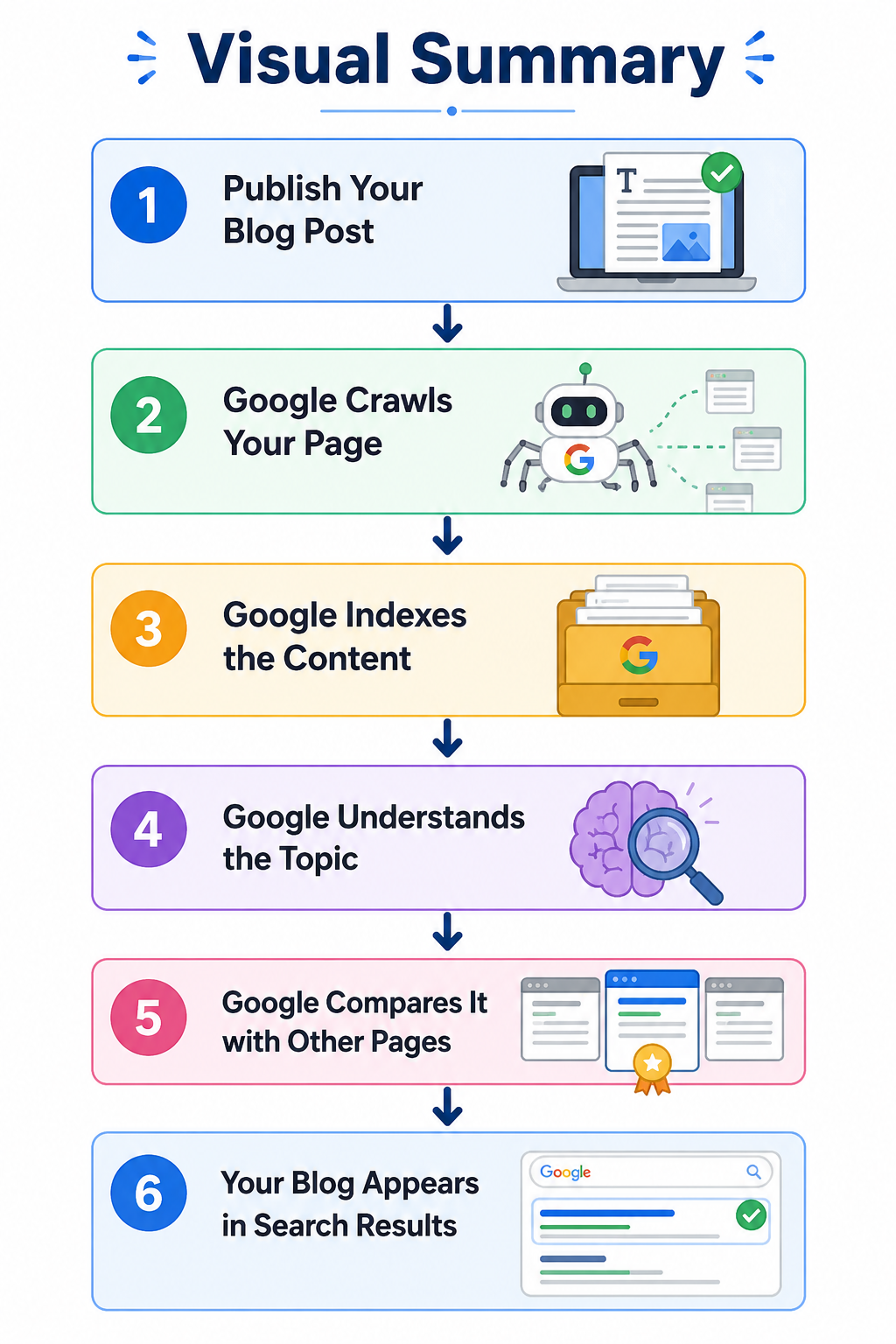

Step 1: Crawling – Google Finds Your Content

The first stage of Google's search process is called crawling. Before your blog post can appear in Google Search, Google must first discover that your page exists.

Imagine Google sending millions of tiny digital robots across the internet every day. These robots, known as Googlebots, continuously travel from one website to another, following links and searching for new or updated web pages.

🤖 How Googlebot Finds Your Content

  • 📄 Through your website's XML sitemap.
  • 🔗 By following internal links from other pages.
  • 🌐 From backlinks on other websites.
  • 📢 When you request indexing in Google Search Console.

Whenever you publish a new blog post, Googlebot attempts to locate and visit that page. If Google never discovers your content, it cannot read or evaluate it. And if Google cannot read your page, it has no way of showing it in search results.

📘 Example

Imagine you publish a new article titled "How To Write SEO Blog Posts That Rank In 2026."

Googlebot visits your website, opens the page, reads the title, headings, text, images, and links, then collects information about your content. This discovery process is known as crawling.

💡 Easy Way to Understand Crawling

Think of Googlebot as a librarian walking through a huge library, searching for new books that have just been placed on the shelves. Before readers can borrow a book, the librarian must first discover it. Google works in a very similar way with web pages.

Step 2: Indexing – Google Stores Your Content

Finding your page is only the beginning. After Google discovers your content, it must decide whether your page deserves to be stored in its search database. This important stage is known as indexing.

Think of Google's index as one of the world's largest digital libraries, containing billions of web pages. Only pages that are successfully indexed become eligible to appear in Google Search results.

📚 What Google Checks Before Indexing

  • 📰 Your page title and headings.
  • 📝 The quality of your main content.
  • 🖼️ Images and media on the page.
  • 📄 Meta description.
  • 🔗 Internal and external links.
  • 🎯 The overall topic and relevance of the article.

If your content is original, helpful, well-structured, and technically accessible, Google is much more likely to add your page to its index. Once indexed, your article has the opportunity to compete for search rankings.

⚠️ Why Some Pages Are Not Indexed

Not every page published on the internet is added to Google's index. Google may choose to ignore pages that provide little value or create a poor user experience.

  • ❌ Very little useful information.
  • 📄 Copied or duplicate content.
  • ⚙️ Technical issues that prevent Google from reading the page.
  • 📉 Low-quality or unhelpful content.

📘 Example

Imagine publishing two blog posts about the same topic.

The first article contains only a few paragraphs copied from another website. The second is a detailed, original guide with clear headings, helpful examples, images, and practical tips.

Google is far more likely to index the second article because it provides genuine value to readers.

💡 Key Takeaway

Before Google can rank your article, it must first believe your page deserves a place in its digital library. Creating original, high-quality content significantly improves your chances of being indexed and appearing in Google Search.

Step 3: Google Understands What Your Article Is About

Once your page has been indexed, Google's next job is understanding what your article is actually about. This is an important step because Google needs to determine which search queries your content should appear for.

Years ago, search engines relied heavily on counting keywords. If a page repeated the same keyword over and over again, it often ranked higher—even if the content wasn't particularly useful.

Today, things are very different. Google has become much smarter. Instead of focusing on a single keyword, it looks at the overall meaning and context of your content to understand the topic you're discussing.

🧠 How Google Understands Your Content

Google looks at multiple signals across your article, including:

  • 📑 Your page title and headings.
  • 📝 Related words and phrases.
  • 🖼️ Images and their context.
  • 🔗 Internal and external links.
  • 📚 Examples and supporting information.
  • 🎯 The overall context and meaning of your content.

📘 Example

Imagine you're writing an article about "How To Write SEO Blog Posts."

Throughout your guide, you naturally include related terms such as:

SEO Writing Keyword Research Search Intent Internal Linking Meta Descriptions Content Optimization

Even if you don't repeat the exact phrase "SEO blog writing" dozens of times, Google can still understand that your article teaches readers how to create SEO-friendly blog posts.

🚫 Avoid Keyword Stuffing

Repeating the same keyword unnaturally in every paragraph doesn't improve rankings. In fact, it can make your content difficult to read and may hurt your SEO performance.

Instead, write naturally and focus on explaining the topic clearly. Use related words, examples, and helpful information to build context.

💡 Key Takeaway

Write for people first, not search engines. When your content is clear, helpful, and well-structured, Google can easily understand the topic through its quality, context, and relevance—without relying on excessive keyword repetition.

Step 4: Ranking – Google Chooses the Best Answers

After Google understands your article, the final stage begins: ranking. This is where Google compares your page with thousands—or sometimes even millions—of other articles covering the same topic.

Google's goal is surprisingly simple: it wants to show searchers the page that provides the best possible answer to their question.

🏆 What Google Looks At Before Ranking Your Page

Google evaluates many quality signals, including:

  • 📝 The quality and originality of your content.
  • 🎯 Whether your article matches the user's search intent.
  • 📖 How easy your content is to read and understand.
  • ⚡ Your website's page loading speed.
  • 📱 Mobile-friendly design and user experience.
  • 🌐 The authority and trustworthiness of your website.
  • 👍 How useful visitors find your content.

📌 Important to Remember

There is no single ranking factor that guarantees the number one position on Google.

Instead, Google looks at the overall experience your page provides. Helpful, trustworthy, and easy-to-read content is much more likely to rank well over time.

🚀 The Secret to Long-Term SEO Success

Successful SEO isn't about finding shortcuts or tricks. It's about consistently publishing valuable content that genuinely helps your readers solve their problems.

The more useful your content is, the more likely Google is to reward it with better visibility in search results.

⏳ Be Patient with SEO

A new blog post rarely ranks immediately. Depending on your competition, content quality, and website authority, it may take several weeks—or even months—for Google to fully evaluate your page.

SEO is a long-term investment. The bloggers who publish high-quality content consistently are the ones who usually achieve the best long-term results.

💡 Key Takeaway

Focus on creating the best possible content for your audience rather than chasing rankings. When your article satisfies readers, loads quickly, provides a great user experience, and answers the search intent better than competing pages, Google is much more likely to rank it higher over time.

Why Search Intent Is So Important

Search intent is the reason behind every Google search. It represents what the user is actually trying to find, learn, or accomplish when typing a query into the search bar.

Understanding search intent helps you create content that answers your readers' questions more effectively. When your article matches what people are looking for, Google is much more likely to rank it higher.

🍰 Example

Imagine you search Google for:

🔍 "How to bake a chocolate cake"

You would probably expect a complete recipe with ingredients, step-by-step instructions, baking tips, and perhaps some helpful images.

Now imagine the first result only explains the history of chocolate cakes without showing you how to bake one.

Even though the information is accurate, it doesn't answer your question. Most people would leave that page and choose another result.

🎯 Why Google Cares About Search Intent

Google pays close attention to how well a page satisfies the user's goal. If visitors quickly leave a page because it doesn't answer their question, Google understands that the content may not be the best match.

That's why search intent has become one of the most important parts of modern SEO.

❓ Ask Yourself Before Writing

"What is the reader really looking for?"

If someone searches for "How To Write SEO Blog Posts", they usually want practical guidance, real examples, useful tips, and clear step-by-step instructions—not just definitions.

The better your article satisfies the reader's goal, the better your chances of ranking in Google Search.

How You Can Help Google Understand Your Content

The good news is that you don't need to trick Google's algorithm. Instead, focus on creating content that is easy for both readers and search engines to understand.

✅ Best Practices

  • 🎯 Choose one clear topic for each article.
  • 📝 Write a descriptive SEO-friendly title.
  • 📑 Organize your content with H2 and H3 headings.
  • 🔍 Use your primary keyword naturally throughout the article.
  • 🏷️ Include related keywords where they fit naturally.
  • 🖼️ Add descriptive alt text to your images.
  • 🔗 Link to other helpful articles on your website.
  • 💡 Create original content that genuinely helps your readers.
💡 Final Takeaway

When readers enjoy your content, stay on your page, and find the answers they were looking for, Google is much more likely to recognize your article as valuable. Focus on helping people first, and strong SEO results will often follow naturally over time.

Visual Summary

Remember This

Now you know what happens behind the scenes after you publish a blog post.
Your article doesn't appear in Google Search instantly. Instead, it goes through a step-by-step process. First, Google discovers your page through crawling. Then it decides whether to add it to its search index. After that, it works to understand what your content is about before comparing it with other pages to determine where it should appear in the search results.

As a blogger, your goal isn't to outsmart Google's algorithm. Your goal is to make Google's job easier by creating content that is clear, well-organized, and genuinely helpful.

When you focus on answering real questions, organizing your content with logical headings, writing naturally, and providing useful information, you're giving both readers and search engines exactly what they're looking for.

Remember, SEO is a long-term journey, not an overnight success. Every high-quality blog post you publish becomes another opportunity for Google to discover your website and connect your content with people searching for answers.

Keep creating valuable content, stay consistent, and over time, your blog will have a much better chance of earning higher rankings and attracting steady organic traffic.

Part 1 → "Continue Reading Part 2"

Frequently Asked Questions (FAQs)

SEO blog writing is the process of creating blog posts that are helpful for readers while also being optimized for search engines. It combines valuable content with proper keyword usage, clear headings, internal links, and a good user experience to improve search rankings.

Yes. Regular blogging often focuses only on sharing ideas or experiences. SEO blog writing goes a step further by understanding what people are searching for and creating content that answers those questions in a way that search engines can easily understand.

Google wants to show users the most helpful and trustworthy information. High-quality content answers questions clearly, provides accurate information, and offers real value. Helpful content is more likely to rank well and attract long-term traffic.

No. Keywords are still important, but Google also looks at content quality, search intent, user experience, page speed, mobile friendliness, backlinks, and overall usefulness before deciding where a page should rank.

Crawling is the first step in Google's search process. Google uses automated bots called crawlers to discover new and updated web pages by following links across the internet.

Indexing is the process of storing and organizing a webpage in Google's search database. If your page isn't indexed, it cannot appear in Google Search results.

Similar Posts