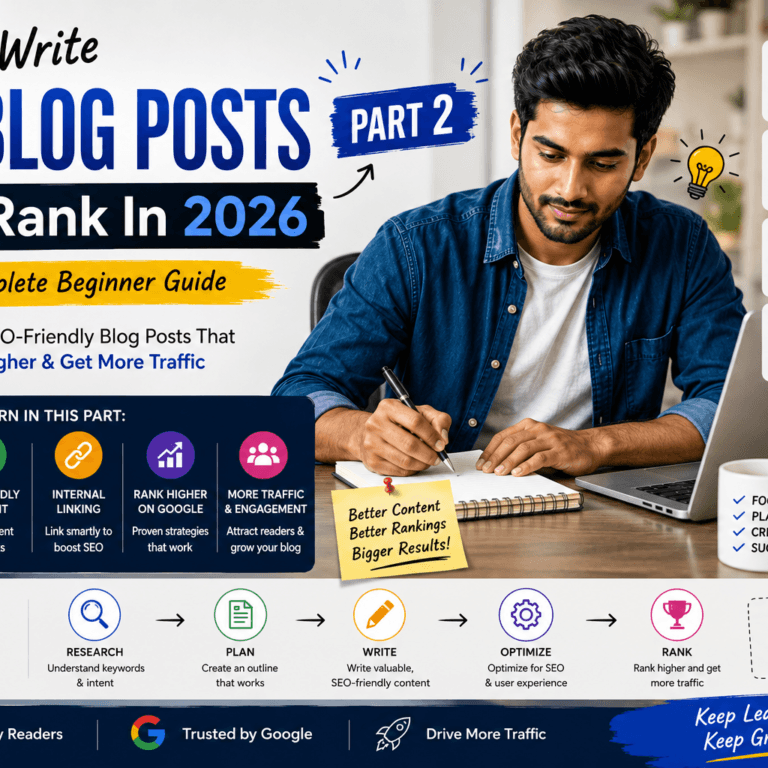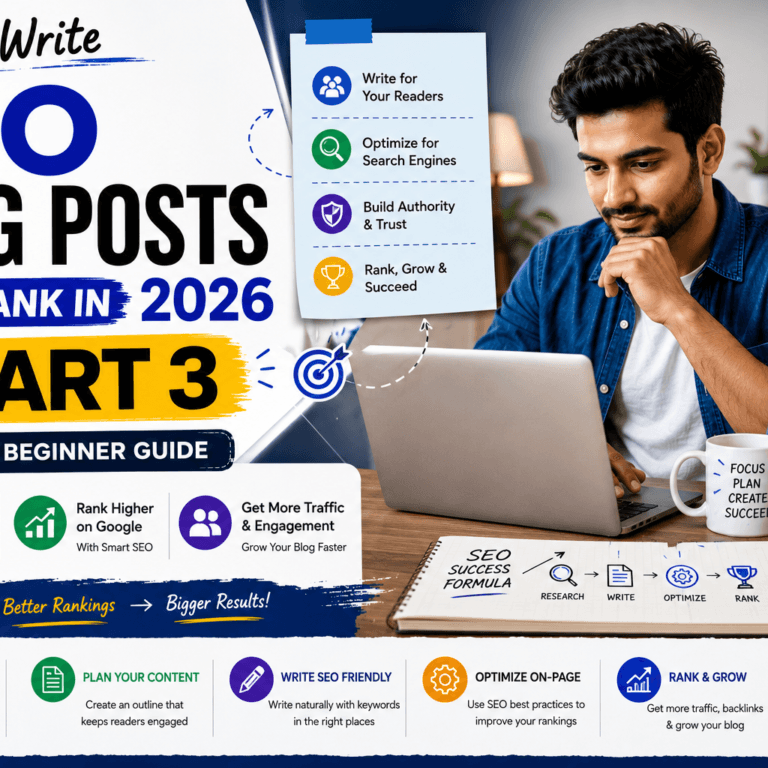
How to Write SEO Blog Posts That Rank in 2026 (Part 4)

Welcome to Part 4 of our complete beginner's guide to SEO blog writing.
You've already completed the most important preparation steps.
If you haven't completed the previous parts yet, we recommend reading How to Write SEO Blog Posts That Rank in 2026 (Part 1), Part 2, and Part 3 before continuing. Each part builds on the previous one and takes you through the SEO writing process step by step.
Now your preparation is complete.
It's finally time to write the main content of your blog post.
This is where many beginner bloggers start to overthink. They worry about using perfect words, adding enough keywords, writing long paragraphs, or making every sentence sound professional.
Because of this, a single blog post can sometimes take days or even weeks to finish.
But SEO writing doesn't need to feel complicated.
Your main goal is simple:
You are not writing to impress people with complicated words. You are writing to help someone understand a topic or solve a problem.
In this part, you'll learn how to:
These simple writing skills can make your blog posts easier for people to read and easier for search engines to understand.
Let's start with the most important rule of SEO content writing: write for people first.
10. Write for People First
When writing an SEO blog post, it's easy to focus too much on Google.
You may start thinking about keywords, headings, article length, and rankings. These things matter, but they should not be your first focus.
Your first goal is simple.
Think about the person who found your article through Google. They clicked because they have a question or need help with something.
Your job is to give them a clear answer.
For example, if someone searches How to Start a Blog in 2026, they probably want to know how to choose a niche, buy a domain name, set up their blog, and publish their first article.
They don't want a long history of blogging.
Give readers the information they came for.
That's what people-first content means.
Explain One Idea at a Time
Don't try to explain everything in one paragraph. If you're teaching keyword research, first explain what a keyword is. Then explain why keywords matter. After that, show readers how to find keyword ideas and choose the right one.
This simple step-by-step flow makes your article easier to follow. Your reader should never feel lost.
Use Simple Language
You don't need difficult words to sound professional.
For example:
Difficult: Implement a comprehensive keyword optimization strategy to enhance organic search visibility.
Simple: Use relevant keywords naturally to help Google understand your content.
The second sentence is much easier to understand. Remember, many people search Google because they want someone to explain a difficult topic in a simple way.
Be that person.
Write Like You're Helping One Reader
Imagine one beginner sitting in front of you and asking for help.
How would you explain the topic to them?
For example:
Formal: Bloggers should identify their target audience before creating content.
More natural: Before you start writing, think about the people you want to help.
The second sentence feels more personal and human. Your blog post should feel like a helpful conversation, not a textbook.
Write for people first. Help them understand the topic. Then think about SEO.
11. Use Keywords Naturally
You already chose your primary keyword in Part 2. Now it's time to use that keyword naturally in your article.
Years ago, some bloggers repeated the same keyword many times because they thought it would help them rank higher on Google.
This is called keyword stuffing.
For example:
"If you want to learn SEO blog writing, our SEO blog writing guide teaches SEO blog writing tips for people learning SEO blog writing."
The keyword appears too many times and the sentence sounds strange. You probably wouldn't speak like this to another person. Your readers don't want to read content like this either. Modern SEO is different. Google tries to understand the complete topic and whether your content is useful to readers.
Use your primary keyword naturally where it fits. You may include it in your title, introduction, some headings, main content, conclusion, URL, and meta description.
But you don't need to force the keyword into every section.
If the keyword fits naturally, use it. If it sounds strange, rewrite the sentence.
Use Related Words and Topics
Google can understand the overall topic of your article.
For example, if your primary keyword is "How to Write SEO Blog Posts," you may naturally talk about keyword research, search intent, SEO titles, blog outlines, content writing, internal links, and on-page SEO.
These related topics help readers understand the complete subject and give your article more depth. Instead of counting how many times you used your keyword, focus on explaining the topic properly.
Read Your Content Naturally
After writing a section, read it again and ask yourself:
"Would I say this naturally to another person?"
If the answer is no, rewrite the sentence.
Your content should feel clear, helpful, and easy to read. Keywords are there to help Google understand your topic. They should never make your writing difficult for readers.
Keywords should support your writing, not control it.
12. Write Short, Easy-to-Read Paragraphs
Most people don't read every word of a blog post from the beginning. They scan the page first. They quickly notice:
Think about how you read an article on your phone. If you see one huge block of text, you may feel tired before you even start reading. Your readers feel the same way.
That's why short paragraphs are important.
Try to keep most paragraphs between two and four sentences. This makes your content easier to read, especially on mobile devices.
Some important sentences can even stand alone.
For example:
Short paragraphs make your article feel clean, simple, and easier to follow.
Use Bullet Points When Helpful
Bullet points work well when you need to explain several ideas quickly.
For example, a helpful SEO blog post should be easy to understand, well organized, relevant to the reader's search, supported with useful examples, and updated when needed. Putting these ideas into a simple list makes them easier to notice and understand.
But don't turn your complete article into bullet points. Use a natural mix of paragraphs, headings, examples, and lists. This keeps your content interesting and comfortable to read.
Break Long Sections With Subheadings
Sometimes one section becomes too long. Instead of writing one large block of content, divide it into smaller topics using H3 headings.
For example, under Write Better Blog Content, you could add smaller sections like Use Simple Language, Write Short Paragraphs, Add Practical Examples, and Avoid Repeating Information.
Now readers can quickly scan the section and find the information they need. Subheadings also make long blog posts feel less difficult to read.
Remember, your reader should never look at your article and think, "This feels like too much work to read." Make your content feel simple. Give readers space.
Guide them one section at a time. Easy-to-read content keeps people reading.
13. Keep Readers Interested
Getting someone to click your article is only the beginning. now you need to give them a reason to keep reading.
Your content should feel helpful from one section to the next.
Sometimes bloggers add extra paragraphs just to make an article longer. But more words do not always mean better content.
After writing a sentence, ask yourself:
"Does this explain, guide, answer, or support my topic?"
If the answer is no, you may not need it.
Respect your reader's time and give them useful information.
Use Practical Examples
Examples help readers connect an idea with something real.
For example, simply saying "Use long-tail keywords" may not be enough for a beginner.
Show the difference.
Broad Keyword: SEO
Long-Tail Keyword: How to Write SEO Blog Posts for Beginners
Now the idea becomes much easier to understand. Whenever you explain a new SEO topic, think about your reader.
Ask yourself, "Can I show a simple example here?"
A small example can sometimes explain more than a long paragraph.
Add Helpful Visuals
Some topics are easier to understand when readers can see them.
For example, an H1, H2, and H3 infographic can help a beginner understand heading structure much faster.If you're explaining Google Autocomplete, a real screenshot can show readers exactly where to look.But don't add images only to make your article look longer.
Every visual should have a purpose. Ask yourself: "Will this image help my reader understand the topic better?" If the answer is yes, add it.
Connect Each Section Naturally
Your blog post should feel like one complete journey, not a collection of random sections.
For example:
"Now that you know how to choose a keyword, the next step is understanding why people are searching for it."
This naturally moves the reader from keyword research to search intent. You can also write: "Once your outline is ready, you can start turning each heading into clear and helpful content." Simple transition sentences show readers what comes next. Think of yourself as a guide.
Your reader is following your article step by step. Don't leave them wondering where the article is going.
Make every section useful, connect your ideas naturally, and always give readers a reason to continue.
Frequently Asked Questions
Continue Your SEO Writing Journey
You've now learned how to turn your research and outline into clear, helpful content that readers can easily understand.
But writing your blog post is only one part of the process.
Before you hit publish, there are still a few important SEO steps to complete. In Part 5, you'll learn how to optimize your blog post using internal and external links, images, on-page SEO, and a final publishing checklist.
Want to review an earlier step?